
Choose Thamel for visitor convenience, Boudha for time around the stupa, or Patan for heritage walks.
Compare Thamel, Boudha and Patan by nearby sights, evenings, airport geography and cross-city travel to choose your Kathmandu Valley base.
The useful short answer is:
- Stay in Thamel for the broadest concentration of visitor services, restaurants and evening activity.
- Stay in Boudha if Boudhanath Stupa and Buddhist sites are the focus of the trip.
- Stay in Patan for historic streets, Newar architecture and several sights that fit naturally into walks.
These bases sit in different parts of the Kathmandu Valley. Rather than looking for one neighborhood that is central to everything, choose the place where you want to start and finish most days.
The comparison at a glance
| Base | Best suited to | Nearby on foot | Main compromise |
|---|---|---|---|
| Thamel | First visits, short stays, trek preparation, restaurants and evening activity | Thamel’s shops and services; a walk through old Kathmandu toward Asan and Kathmandu Durbar Square | Busy, visitor-oriented streets; room location matters for noise |
| Boudha | Trips centred on Boudhanath and Buddhist institutions | The stupa circuit and surrounding lanes | More cross-city travel for old Kathmandu and Patan |
| Patan | Architecture, crafts, museums and slower heritage days | Patan Durbar Square, Patan Museum, Golden Temple and nearby courtyards | Less convenient when most plans are in Thamel or eastern Kathmandu |
Boudhanath and Patan Durbar Square are substantial anchors, not minor neighborhood sights. Both are among the seven monument zones that make up the UNESCO-listed Kathmandu Valley property. UNESCO identifies Boudhanath as the site of Nepal’s largest stupa and Patan as one of the property’s three historic urban centres, with palaces, temples and public spaces (UNESCO World Heritage Centre).
Thamel: the convenient visitor base
Thamel is the most practical default for a short first stay or the nights around a trek. The Nepal Tourism Board describes it as Kathmandu’s tourist district, with scores of hotels as well as restaurants, bars, bookshops, souvenir shops and travel agencies. It also says the area remains active late into the night (Nepal Tourism Board).
That concentration makes routine visitor tasks easier: finding food, shopping for equipment and speaking to travel businesses need not require a journey across the city. Thamel also gives walkers a route into old Kathmandu. A Nepal Tourism Board heritage walk runs between Thamel and Kathmandu Durbar Square via places including Kathesimbu Stupa and Itum Bahal (Nepal Tourism Board).
The drawback is the same concentration of activity. Do not treat “Thamel” as a precise location when choosing a room. Check the property’s pin, its recent reviews for nighttime noise and its distance from the places you expect to use. A room on an active bar lane and one in a courtyard or near the district’s edge can present different tradeoffs.
Choose Thamel if:
- this is a short first visit;
- you want restaurants and visitor services close together;
- you need trekking shops or travel agencies;
- you expect to go out in the evening.
Choose another base if: Boudhanath or Patan’s historic core is the principal reason for the stay.
Boudha: for repeated time around the stupa
Boudha makes sense when Boudhanath is more than one stop on a sightseeing circuit. The Nepal Tourism Board places it 8 km east of downtown Kathmandu and describes it as a centre of Himalayan Buddhism (Nepal Tourism Board). Staying nearby allows repeated visits rather than compressing the area into a single cross-city outing.
For that benefit, look for accommodation within a comfortable walk of the stupa circuit. Check the actual walking route rather than relying on the word “Boudha” in a listing or a straight-line distance. A major road can matter more than a small difference on the map.
Boudha should not automatically be read as silent. The stupa is an active religious and public place, and the surrounding neighborhood has city traffic. If quiet is important, ask whether the room faces a main road, the stupa area or an inner courtyard.
Boudha is also on the eastern side of Kathmandu. Tribhuvan International Airport describes its own location as 5.56 km east of Kathmandu city (Tribhuvan International Airport). Those broad locations do not establish a dependable transfer time or a shorter airport journey than another base: compare the exact hotel route and conditions at the time.
Choose Boudha if:
- Boudhanath and nearby Buddhist institutions are central to the trip;
- you want to return to the stupa at different times of day;
- most plans lie in eastern or northeastern Kathmandu;
- Thamel’s evening scene is not a priority.
Choose another base if: most days begin in old Kathmandu or Patan.
Patan: for heritage walks
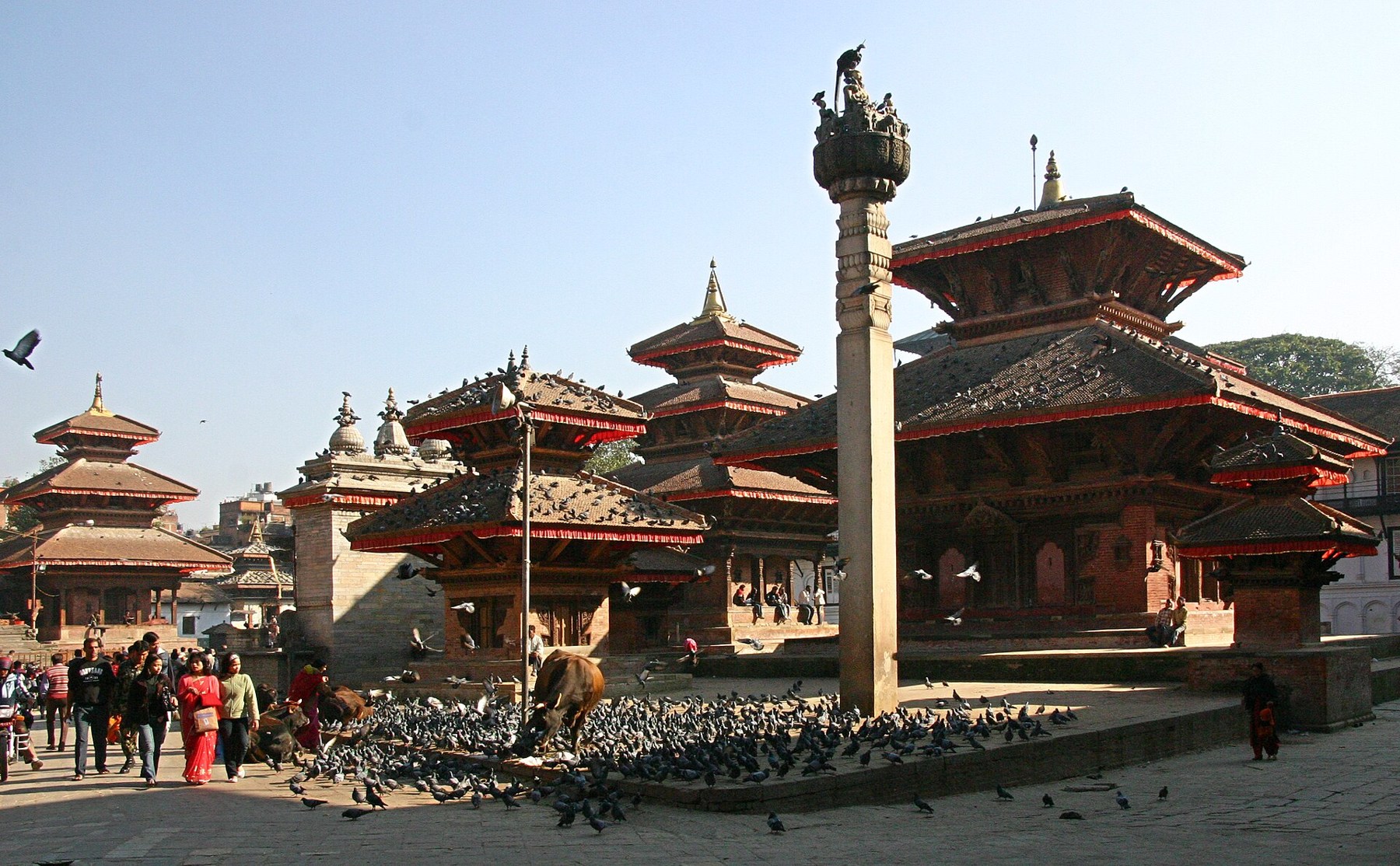
Patan, also called Lalitpur, is the strongest of these three choices when the historic city itself should shape the stay. The Nepal Tourism Board places it southeast of Kathmandu and describes its narrow streets, brick houses, Hindu temples, Buddhist monasteries and preserved metalworking traditions (Nepal Tourism Board). The official Patan Museum site places the museum inside the Patan Durbar Square complex (Patan Museum).
The old core supports a sequence of nearby sights rather than one isolated monument visit. A tourism-board heritage route begins at Patan Durbar Square and includes Hiranya Varna Mahavihar, better known as the Golden Temple, Mahabouddha and Rudra Varna Mahavihar (Nepal Tourism Board). Staying near the square makes it easier to divide these places across several shorter walks.
Location wording deserves care here too. “Patan” and “Lalitpur” can describe a much wider area than the lanes around Durbar Square. For a heritage-focused stay, check the walking route to Patan Durbar Square. Jawalakhel, Jhamsikhel and Pulchowk may suit other priorities, but they are not interchangeable with a room in the old core.
Patan’s compromise is cross-city travel. Thamel lies north of the Bagmati, while Boudha and the airport are farther east. Patan remains a workable base for wider valley sightseeing, but its location pays off most when Patan itself receives meaningful time rather than a brief stop.
Choose Patan if:
- architecture, crafts and religious history matter more than nightlife;
- you prefer several short heritage walks to one hurried circuit;
- Patan Durbar Square and Patan Museum are priorities;
- you want to stay near the old city rather than commute to it.
Choose another base if: the itinerary is dominated by Thamel, Boudha or eastern Kathmandu.
Let repeated journeys break a tie
Kathmandu Valley has public buses, battery-powered three-wheelers and taxis. The Nepal Tourism Board says Sajha buses use designated stops along major north–south and east–west roads, while other buses serve different parts of the valley; taxis are another option (Nepal Tourism Board). That overview does not provide dependable neighborhood-to-neighborhood journey times, so avoid building an itinerary around one fixed estimate.
Use four practical checks instead:
- Count repeated crossings. One cross-city outing is different from making the same journey twice every day.
- Check the last part on foot. A property’s map pin and the actual walking route to the neighborhood anchor may tell different stories.
- Ask about vehicle access. If travelling with substantial luggage, confirm where the property expects a taxi to stop.
- Allow an airport buffer. None of the three bases comes with a guaranteed transfer time.
Room price alone can also mislead. Compare the saving with the extra journeys the location would create.
Should you split the stay?
A split stay can work when two neighborhoods are major parts of the trip—for example, Thamel before a trek and Patan afterward, or Patan followed by Boudha on a culture-focused visit. It is less persuasive when the schedule is short enough that checking out, moving luggage and checking in would consume a substantial part of a day.
There is no universal night-count threshold. Base the decision on whether changing hotels removes several repeated cross-city trips, not simply on the total length of the visit.
How to make the final choice
Choose Thamel when convenience, visitor services and evening choice matter most. Choose Boudha when repeated time around Boudhanath is the purpose of the stay. Choose Patan when historic streets, art and architecture should be immediately accessible.
Before booking, verify three things on a map: the exact property pin, the walking route to the relevant anchor—central Thamel, Boudhanath Stupa or Patan Durbar Square—and the road journey to the place you must reach earliest. Those checks are more useful than any claim that one district is simply “best.”